

Context: In the Azarenok. Napryamuyu show on CTV, host Ryhor Azaronak and publicist Yuri Terekh attempted to justify the lifting of American sanctions on Belarusian potash by claiming that it was easier for Washington to negotiate with Minsk than with Moscow. The Weekly Top Fake team explained why this logic doesn’t work. The restrictions applied only to Belarusian potash companies. Russian potash was not covered by the U.S. ban and continued to be exported to the United States, even while sanctions against Belarus were in place. Additionally, Russia has increased its potash exports during this period. The U.S., however, continues to rely heavily on more affordable Canadian supplies.
On March 25, 2026, the ONT TV channel’s program Obyektivno continued the discussion of potash and negotiations with the United States, seeking to explain why Belarus engages in this dialogue at all. According to Andrei Savinykh, a former diplomat and MP who is now the deputy chairman of the Liberal Democratic Party of Belarus, Minsk has a pragmatic economic interest.
“If we can leverage the global situation to promote some of our economic interests, including the sale of [potash] fertilizers... As we know, the prices of these fertilizers have doubled globally because of the conflict in the Middle East,” he said.
Since the war with Iran began, the price of potash has barely budged. In March, it remained at about the same level as in February. Looking at the year’s dynamics, growth was about 6%, not 100%.
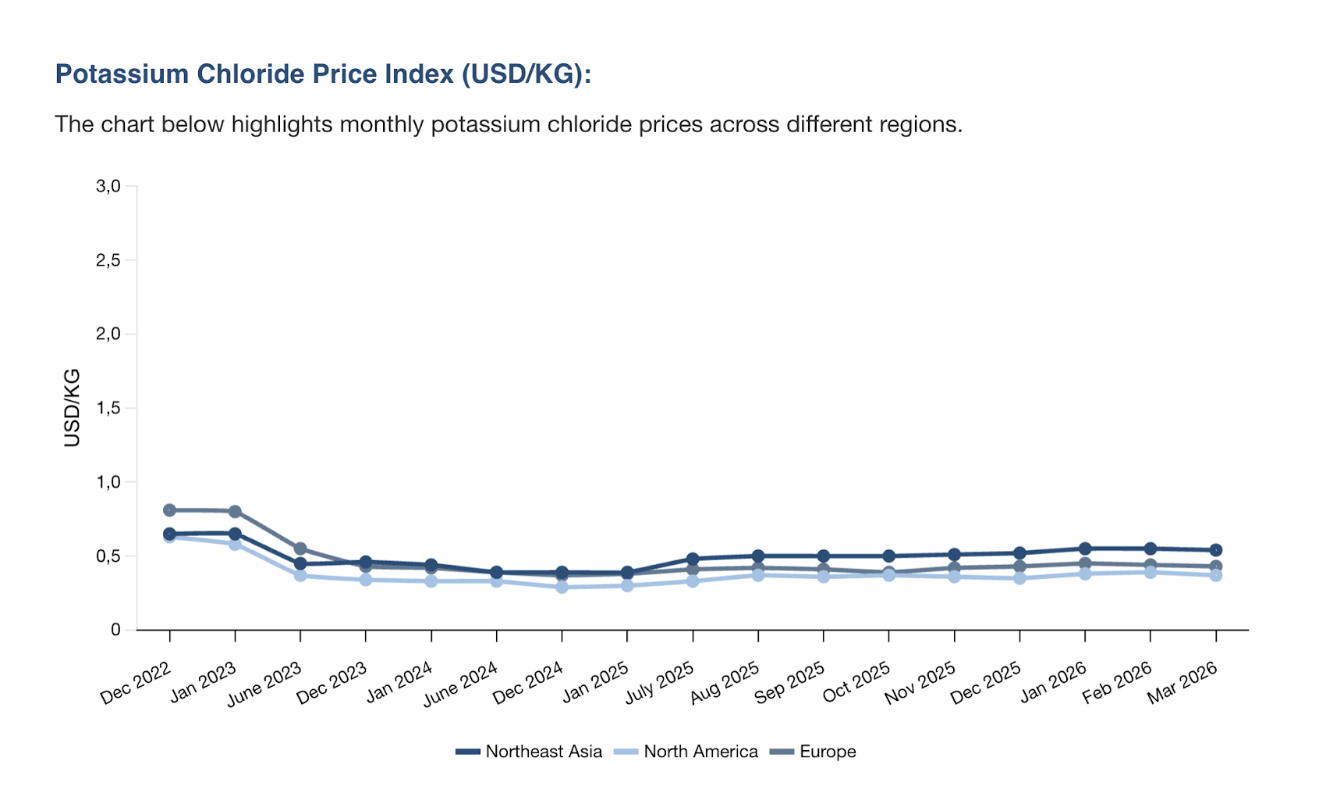
Source: IMARC Group
Meanwhile, during the period of sanctions on Belarusian potash, Russia boosted its potash fertilizer exports by roughly one-third — from 9.6 million tons in 2020 to 13.3 million tons in 2025.
Following the start of the war, the price of nitrogen fertilizers, primarily anhydrous ammonia and urea, increased more than that of potash fertilizers. However, even in their case, the price increase was not double, but rather up to 50%. The reason for the price jump is that the production of nitrogen fertilizer depends on gas. The Strait of Hormuz’s blockage threatened gas supplies, driving up gas prices and, in turn, nitrogen fertilizer prices.
Belarus continues to trade in nitrogen fertilizers, getting around the sanctions against Grodno Azot. EU countries, including Poland, the Czech Republic, and Germany, purchase these fertilizers. However, the volume of these supplies is not comparable to that of potash, and there is no significant supply in the U.S.
Andrei Savinykh is correct in one respect: the free sale of potash will benefit the Belarusian economy. However, the claim that the conflict has doubled fertilizer prices and that Belarus will benefit greatly from this does not reflect the current state of the potash market.