


The Belarusian Investigative Center analyzed data on deliveries from 50 Belarusian enterprises to Russian arms manufacturers between February 2022 and August 2025 and identified five private companies that have profited the most from these supplies.
The largest deal among private Belarusian firms was made by Minsk-based Abaronnyja Inicyjatyvy. In 2024, it supplied an item labeled I218-22, classified as radar and other equipment, to the sanctioned Russian aircraft manufacturer Tupolev for more than $2 million. Tupolev produces missile carriers, including the Tu-22M3 bomber used in Russia’s war against Ukraine.
Second in the ranking is VTT, a company from Smarhon that produces vacuum technology. In 2023–2024, it supplied equipment worth more than $1.5 million to VOMZ and KMZ, both part of Shvabe, a holding company within the sanctioned Rostec State Corporation. The two Russian companies produce sniper and armored vehicle sights.
Third is BAZDorMash, which supplied hydraulic cylinders and other components to the Kalinin Machine-Building Plant, a producer of equipment for Buk-M1 and S-300V air defense systems, as well as to KAMAZ and other Russian companies linked to military production.
Fourth is Minotor-Service Enterprise, which has long worked with Russia’s defense sector. From 2022 to 2025, it supplied nearly $1.2 million worth of parts for tracked vehicles and other military-related equipment to Russian defense enterprises.
Fifth is Kvand IS, sanctioned by the US in 2024 for supplying drone technology to Russia’s defense sector. BIC found that it delivered optoelectronic stations, drone control devices and digital cameras worth almost $600,000 to Almaz, part of the sanctioned Almaz-Antei concern.
BIC notes that two companies in the ranking, VTT and BAZDorMash, were not under sanctions at the time of publication, despite documented cooperation with Russian defense-linked enterprises.
The BIC received data on deliveries to Russian arms manufacturers from 50 Belarusian enterprises, covering February 2022 through August 2025, from a source in the logistics sector. From this array of data, we have identified five private companies that have profited the most from these supplies. Meanwhile, some of them have not faced restrictions from Western countries, despite their cooperation with sanctioned enterprises. Some company owners continue to operate in the European and US markets.
We used the term “private companies” to refer to businesses whose owners, as stated in their corporate documents, are private individuals. This group did not include organizations from the State Authority for Military Industry system, even though they are not state-owned.
#1 Oboronnye Initsiativy: A $2 million delivery
Among private Belarusian companies, the largest deal with a Russian military-industrial complex enterprise by value goes to the Minsk-based military manufacturer TAA Abaronnyja Inicyjatyvy. Eight months after Russia’s full-scale invasion of Ukraine, a company official told reporters that the company does not supply products to Russia. The BIC identified at least one such shipment. In 2024, the company delivered the I218-22 item — classified as radar and other equipment — to Russian aircraft manufacturer JSC Tupolev in a deal worth more than $2 million. Starting in 2019, the US, the EU, and eight other countries imposed a range of sanctions against this Moscow-based company. It designs and manufactures missile carriers, such as the Tu-22M3 strategic bomber that carries the Kh-22 cruise missile. This missile is currently being used in the war against Ukraine.
The documents do not specify what the “I218-22” designation refers to. According to Ivan Siutsou, a former senior researcher at the Institute of Physics of the National Academy of Sciences of Belarus and PhD in Physics and Mathematics, the term “article” can refer to a prototype of military products.
“For example, the prototypes of nuclear bombs were called ‘item such-and-such.’ In theory, such names could [refer to other goods], but it is unlikely. Usually, if an item can be named in any way, it is given a more specific name in documents to prevent confusion.”
Belarusians Dzianis Pashchanka and Uladzimir Melikayeu are the co-founders of Abaronnyja Inicyjatyvy. [*] [*] Pashchanka was a member of the Council for Entrepreneurship Development under the Minsk City Executive Committee in 2010 and of the Public Advisory Council for Entrepreneurship Development under the State Authority for Military Industry from 2012 to 2017. [*]
The second founder’s bio contains details that don’t fit together well. On the one hand, the press service of the State Authority for Military Industry of the Republic of Belarus quoted Melikayeu as a representative of Oboronnye Initsiativy and called the company a flagship of the national defense industry. Before establishing this company, he worked for UP Tetraedr from 2003 until at least 2021. Tetraedr produces military radio-electronic systems and is associated with the military-industrial complex. On the other hand, Melikayeu was recognized as a political prisoner by the Viasna human rights organization. In 2025, he was sentenced to a term of imprisonment by the Minsk City Court on charges of inciting hatred or discord (article 130 of the Belarusian Criminal Code). Following a visit to Minsk by John Coale, the US President’s special envoy, Melikayeu was pardoned in March 2026.
The Viasna Human Rights Center refers to Article 130 of the Criminal Code as “a common tool of the regime to combat dissidents.”
It is primarily used to prosecute individuals for their online statements, such as the “publications criticizing the regime and negative statements about government representatives, comments on social media and public chats, transmitting information about security forces and officials to protest structures.”
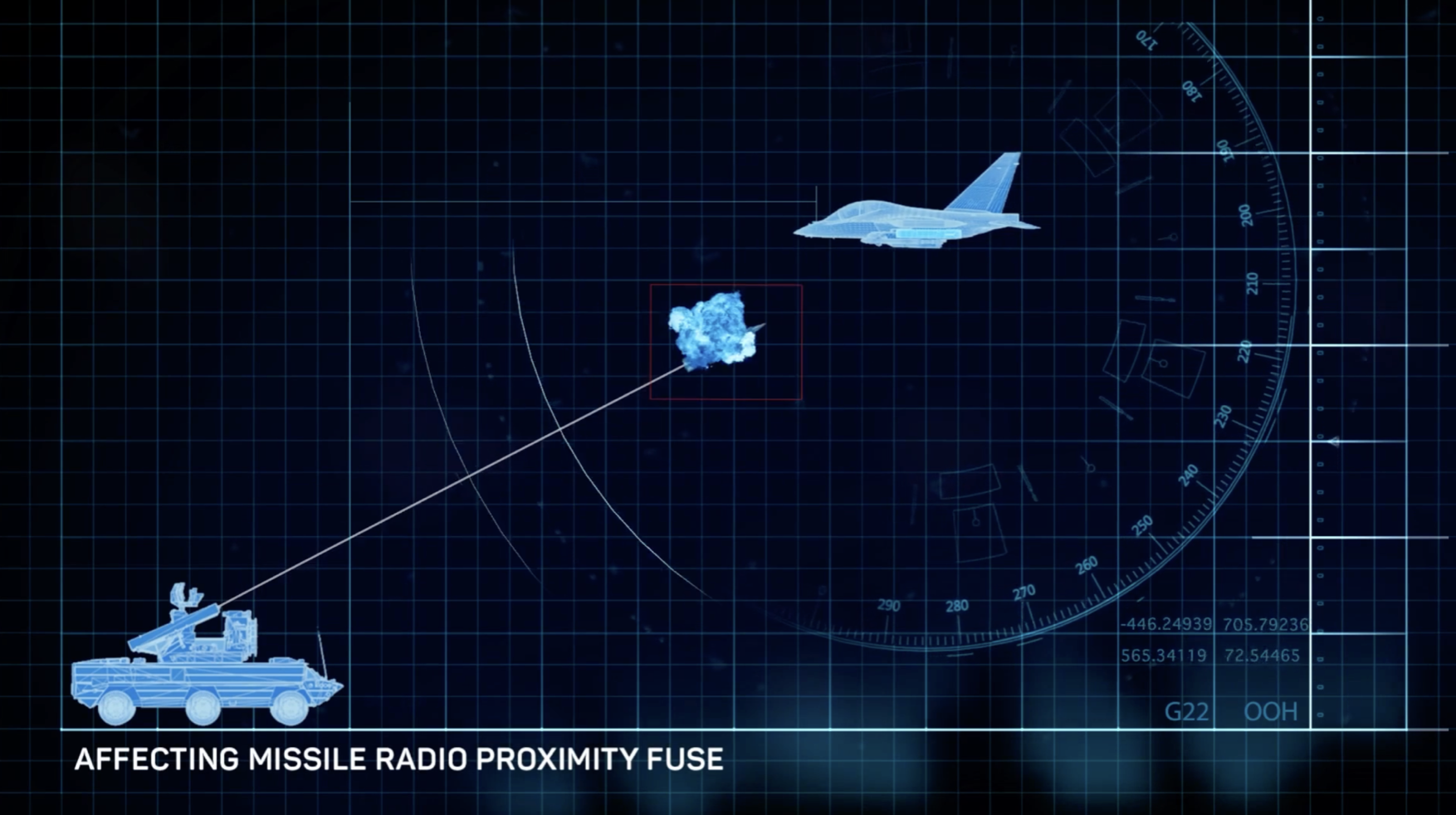
#2 VTT: A family-run business
Four out of five founders of the second-ranked company in our rating are family members. The Smarhon-based TAA VTT is owned by sisters Lidziya Huletskaya and Palina Ralevich, both of whom have the maiden name Vysotskaya. Their mother, Natallia, and their uncle, Avianir, are also co-owners of the company. [*] [*]
The fifth owner is a family acquaintance named Rustem Maiseyeu. There is little public information about the latter three. For example, we know that Natallia and Avianir have retired. Lidziya and Palina do not expose their connection with the company. Lidziya works in video director, and Palina promotes confectionery business on Instagram. All of them earn money from contracts with Russian arms manufacturers, among other things.
VTT specializes in producing vacuum technology. In 2023–2024, the company supplied vacuum units and other components worth more than $1.5 million to OAO VOMZ (Vologda Optical-and-Mechanical Plant) and PAO KMZ (the Krasnogorsk Plant named after S.A. Zverev). These Russian companies produce sniper sights and armored vehicle sights. Both companies are part of the Shvabe holding company, which is part of the Rostec State Corporation. The United States, the European Union, Japan, Canada, Switzerland, Australia, New Zealand, and the United Kingdom have imposed sanctions on Rostec.
Vacuum technology plays a significant role in the production process of sights, according to physicist Ivan Siutsou.
“All decent sights are vacuumed and filled with a dry, neutral gas, such as nitrogen or a noble gas. Therefore, vacuum units are definitely needed. This prevents fogging and corrosion.”
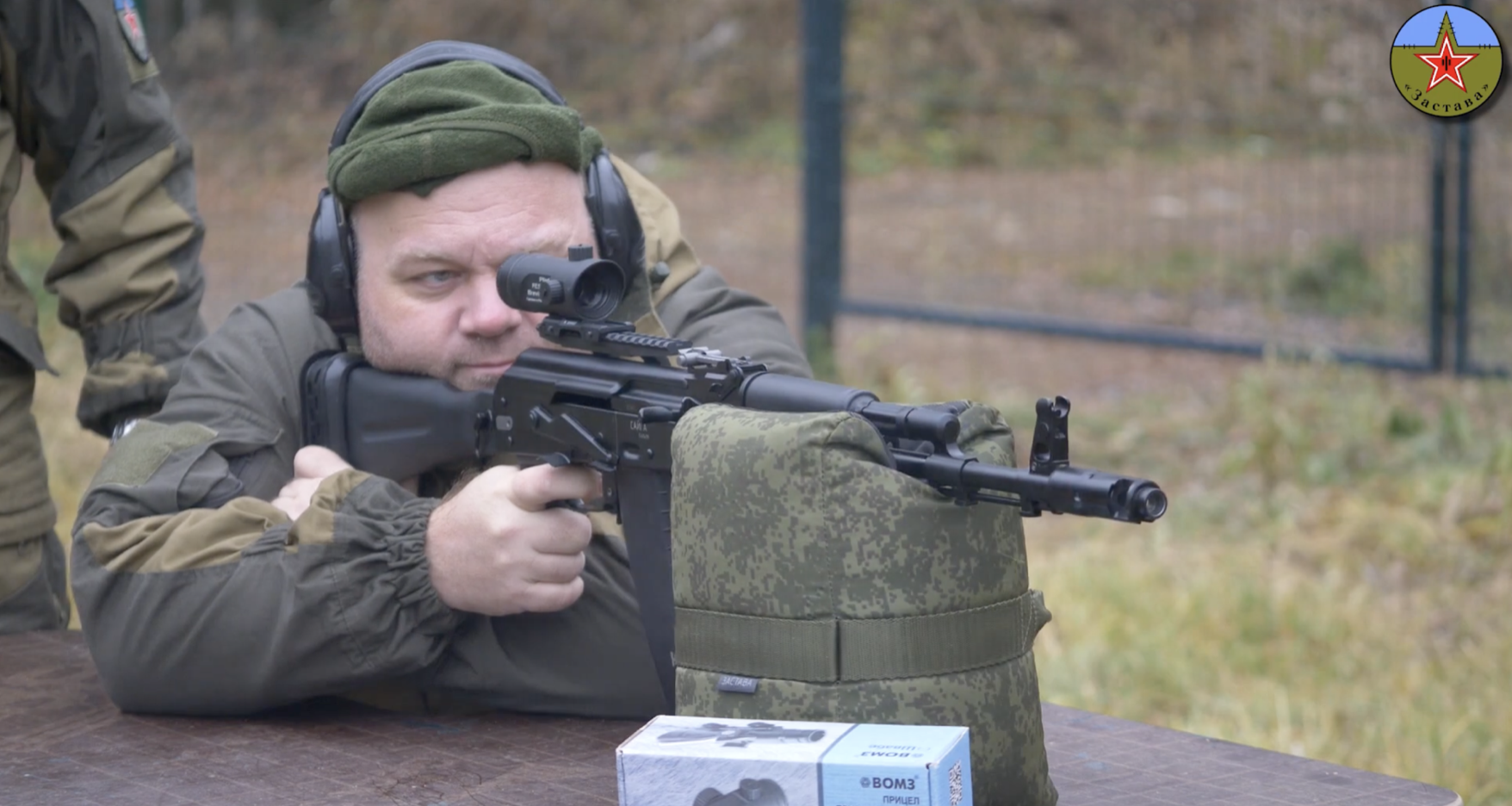
Aliaksandr Ralevich, the deputy head of production and husband of company co-owner Palina Ralevich, is one of the publicly visible people associated with VTT. He is listed as the contact person for job applicants.
In 2025, Ralevich and his partners registered TAA Spektralnyja Prybory i Sistemy in the Minsk District. One of the new company’s co-owners is Rustem Maiseyeu, a co-owner of VTT. At the time of publication, the company did not have its own website or email address. According to the state registry, the company’s activity is the production of optical devices. [*] [*]
To learn more about the new company’s operations, a BIC journalist called Aliaksandr Ralevich while posing as a representative of a fictitious Russian company acting on behalf of the Shvabe holding. Not only did Ralevich agree to discuss cooperation between Spektralnyja Prybory i Sistemy and the sanctioned Russian holding, but he also confirmed VTT’s willingness to participate.
“I think we can discuss a few issues. If you are interested, I can offer vacuum equipment and installations. The company VTT is the producer. I can also offer desktop instrumentation and control systems.”
In 2025, the BIC described the other vacuum technology companies that comprise the Izovac group. The companies within the Izovac group, which has a 30-year history and, according to its co-founder, counts Apple among its former partners, has supplied $200 million worth of goods to the Russian military-industrial complex.

Defense client deal volume presumably reached $200 million over three years.
#3 BAZDorMash: Spare parts for “the most sanctioned enterprise in the Russian Federation”
Third on our list of private companies is Zhodzina-based Bazdormash LLC (TAA BAZDorMash), the successor of TDA Belautazapchastka. The company manufactures hydraulic cylinders and other industrial products.
It was hydraulic cylinders, along with non-porous rubber products and filters with valves, that BAZDorMash supplied in 2022–2025 to PAO MZIK (the Kalinin Machine-Building Plant), which manufactures equipment for the Buk-M1 and S-300V surface-to-air missile systems and is under sanctions from the EU, the United States, Canada, Ukraine, and Switzerland. The total value of deliveries is $566,000. Hydraulic cylinders are widely used in various industries and types of machinery. Therefore, we cannot claim that the supplied parts were specifically used for producing armaments.
From 2022 to 2025, the Belarusian company supplied two additional Russian enterprises, KAMAZ PTC and OOO STFK KAMAZ, with installations and engines valued at more than $792,000. KAMAZ produces the trucks that the Russian army is using in its war against Ukraine. The press service dubbed the auto concern “the most sanctioned enterprise in Russia.”
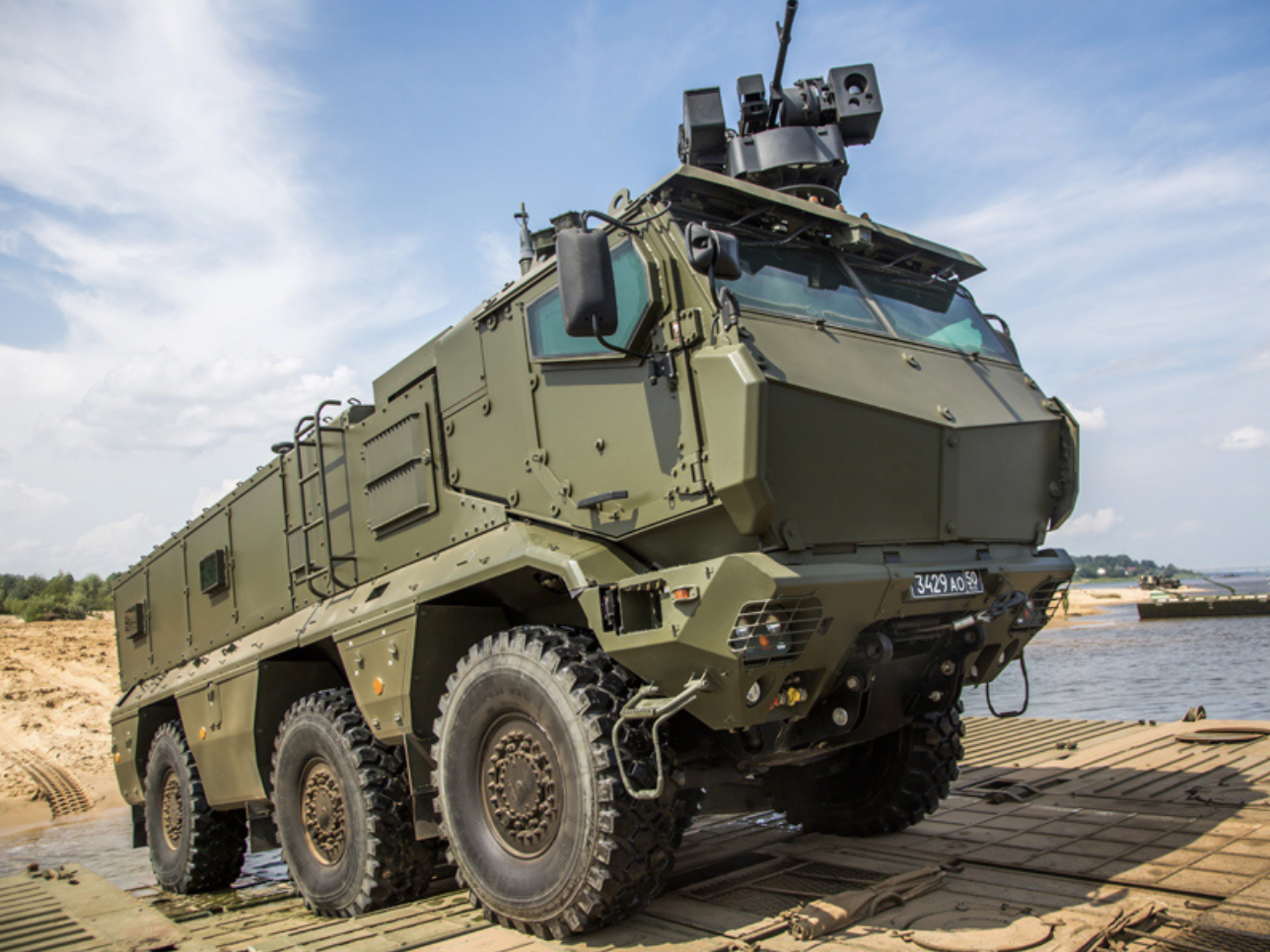
The Belarusian company sold eight hydraulic cylinders to Arms Division LLC for about $1,000. This Russian company produces Tigr-M armored vehicles for the Russian Ministry of Defense, as well as combined gunner’s sights for the BTR-82A armored vehicle.
#4 Minotor-Service: Following Lukashenko’s order
Fourth place in our ranking goes to the company that, in 2016, Aleksandr Lukashenko said he hoped would grow — along with other private enterprises — into “powerful defense-sector structures that would work not only for domestic needs but also for foreign consumption.” A few years later, these words became a reality for Minotor-Service Enterprise (UP Minator-Servis). From 2022 to 2025, the company supplied the Russian military-industrial complex with final drives, seals, tracks, road wheels, hoses, and other components that may be used in the production of military equipment, totaling nearly $1.2 million.
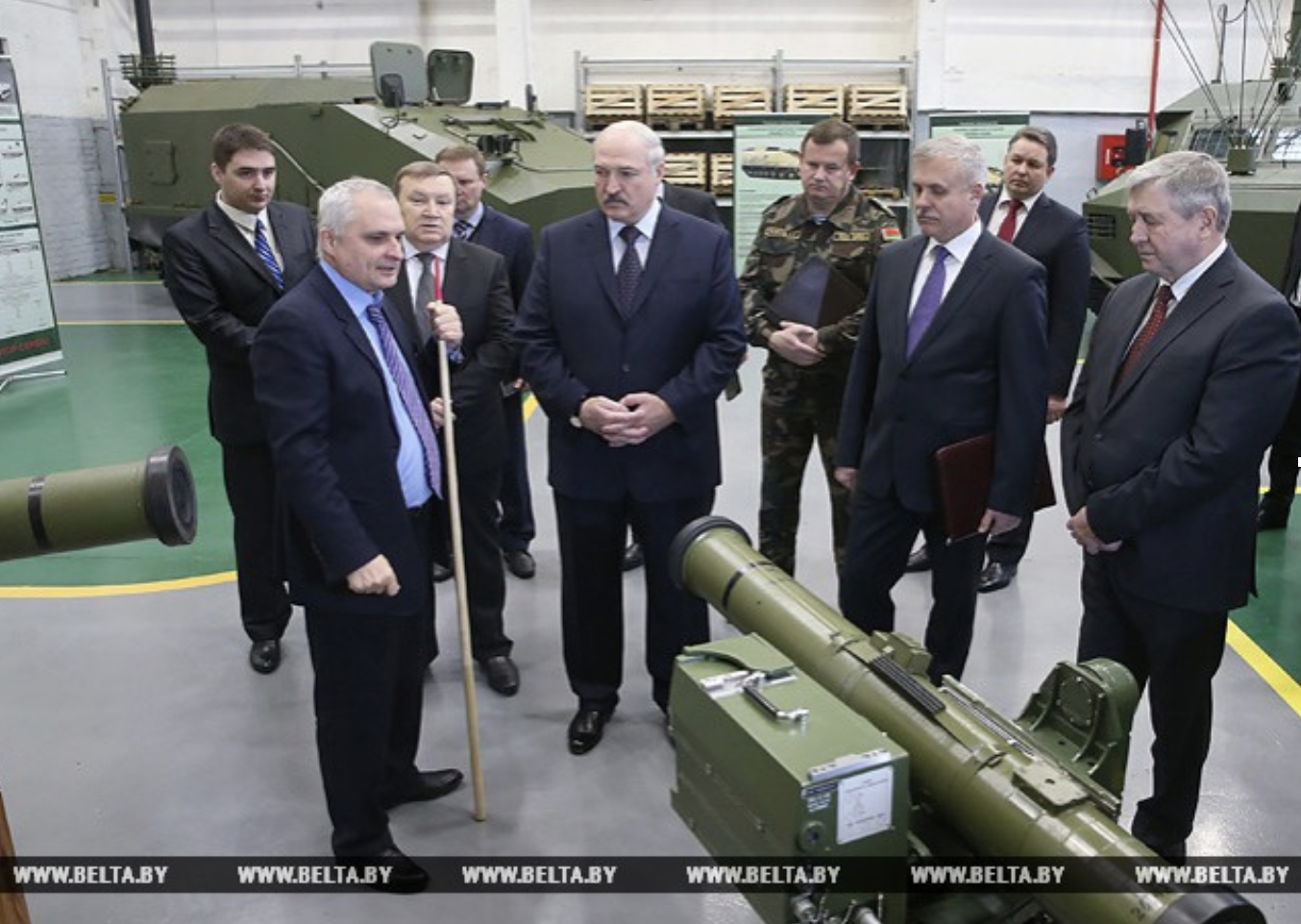
Ivan Siutsou noted that most of the listed parts are intended for use in the production of tracked vehicles. Road wheels, for example, are designed for tracked tractors, which are primarily used by the military. The company supplied them to the Kalinin Machine-Building Plant. This company is under sanctions by the EU, the US, Canada, Ukraine, and Switzerland.
Other Russian customers of Minotor-Service Enterprise that manufacture, repair, and maintain weapons and military equipment include AO UMZ (Ulyanovsk Mechanical Plant) and AO 75 Arsenal. The latter overhauls radar stations, air defense systems and complexes. The EU, US, Canada, and Switzerland have imposed sanctions on the former, while only the US has imposed sanctions on the latter.
Minotor-Service began collaborating with the Russian military-industrial complex long before the Russian invasion of Ukraine. In 2014, it was the only Belarusian enterprise to perform the assembly-line serial repair and maintenance of military equipment ordered by the Russian Ministry of Defense. From 2023 to 2025, the company developed tracked and wheeled military equipment in accordance with the agreement on implementing a joint program of military-technical cooperation between Minsk and Moscow. The enterprise participated in the program alongside giants of the Belarusian defense industry, including JSC Peleng (TAA Peleng), JSC Display Design Bureau (AAT Kanstruktarskaje Bjuro Dysplej), and OJSC MZKT (AAT MZKC), among others.
#5 Kvand IS: Trading technologies despite being a sanctioned company
In June 2024, Washington imposed sanctions on Minsk-based Kvand Is OOO (TAA Kvand IS), the fifth company on our list, for supplying drone technology to the Russian Defense Ministry and for “operating or having operated in the defense and related materiel sector of the Russian Federation economy.” The US Treasury Department has stated that the company has developed reconnaissance UAVs and loitering munitions, also known as kamikaze drones.
The BIC revealed that, in March 2024, the company supplied PJSC ALMAZ R&P Corp. with optoelectronic stations, pivoting devices for controlling reconnaissance and strike drones, and digital cameras. The delivery cost was nearly $600,000. PJSC ALMAZ R&P Corp. is a Russian military-industrial complex enterprise and part of AO "KONTSERN VKO "ALMAZ - ANTEI", which is under sanctions imposed by the United States, the EU, Canada, Australia, New Zealand, Japan, Switzerland, Ukraine, and the United Kingdom. The company produces surface-to-air missile platforms, the S-25 Berkut anti-aircraft missile system, and the S-75, S-125, S-200, and A-35 missile defense systems, as well as other installations.
At the time the deliveries were made, the co-owners of Kvand IS were Aliaksei Stratsilatau, Yury Kapacheuski, and Siarhei Tytsyk, all Belarusian nationals. [*] [*] In a written comment to the BIC, Siarhei Tytsyk only confirmed that Kvand IS had sent the pivoting devices to Russia. However, he noted, “It’s not used at war, that’s for sure.”
“The rest [the supplies of other goods to Russia — ed. note] is nonsense. It cannot be used for drones. <...> In general, I have an official position in Belarus, and everyone knows it: Do not supply military equipment to Russia or Ukraine,” Tytsyk added.
Meanwhile, the shareholders of Kvand IS operate in Western Europe and the US markets. Siarhei Tytsyk is the current majority owner and director of the company. He was also a co-owner of UAVOS GmbH, a Swiss company that was liquidated in 2025. The Swiss company’s co-founders also included Yury Kapacheuski, the current minority co-owner of Kvand IS, and Aliaksei Stratsilatau, who owned a stake in Kvand IS until July 2024. According to his LinkedIn profile and the company’s website, Stratsilatau has managed US-based UAVOS since 2010. Yury Kapacheuski, the current minority shareholder of Kvand IS, heads the board of Poland’s UAVLAS sp. z o.o. [*]
In addition, Vadim Tarasov, a Russian citizen with an Israeli passport, was also a shareholder in the Swiss company, making him a business partner of these individuals in that entity before its liquidation. According to him, he has been permanently residing in Spain since 2001. The businessman is also a member of the supervisory board of a Polish company and a member of the board of directors of a U.S. legal entity. Vadim Tarasov had no connection to the Belarusian Kvand IS.
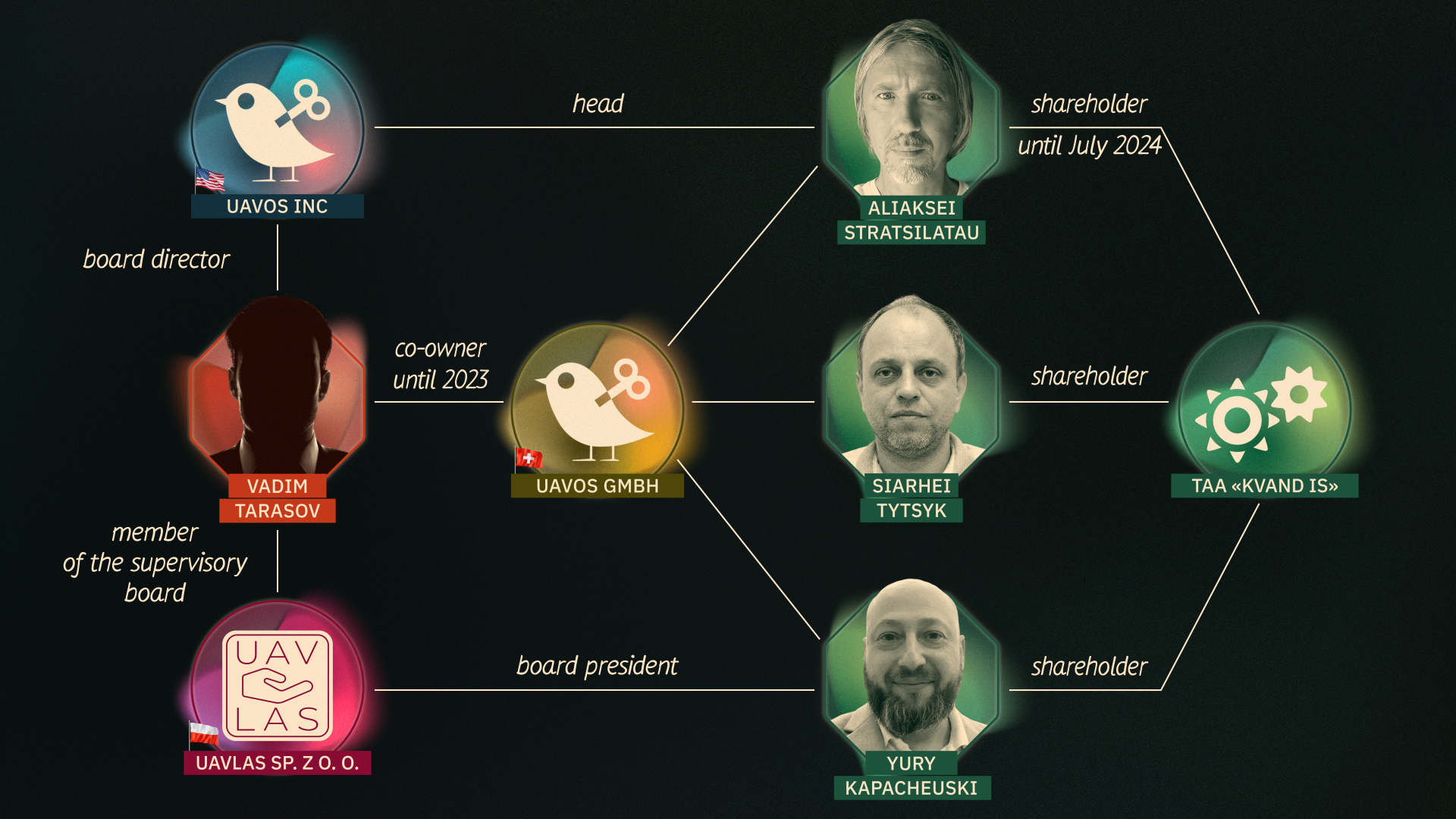
The BIC has no evidence suggesting that Tarasov, Stratsilatau, Kapacheuski, or their companies in the US, Poland, and Switzerland were involved in circumventing sanctions. Kapacheuski and Stratsilatau claim that their involvement as shareholders with the Belarusian Kvand IS at the time of its delivery to the Russian PJSC ALMAZ R&P Corp. was nominal, and they have no information about the delivery. Below are their full responses to the inquiries we received after publication.
Aliaksei Stratsilatau told BIC that he stopped participating in Kvand IS activities “around 2021 when it became clear that doing business in Belarus was no longer possible.” He claims that he has never been involved in the operational management of Kvand IS. He also has never managed the company’s sales, deliveries, foreign trade transactions, or contracts.
“UAVOS Inc. did not participate in, organize, coordinate, finance, support, or benefit from any deliveries by Kvand IS OOO to PJSC ALMAZ R&P Corp. or other entities in the Russian military-industrial complex. UAVOS Inc. does not conduct business with Russian defense entities or supply products, technologies, or services to the Russian military-industrial complex. Nor was I personally involved in organizing, coordinating, or accompanying such deliveries.”
Yury Kapacheuski stated that the Polish company UAVLAS currently has no active business relationships with Kvand IS. He emphasized that he maintains personal contact with Siarhei Tytsyk because they have an unresolved financial issue. For this reason, he has not withdrawn from Kvand IS as a shareholder.
“I have essentially not been involved in the affairs of Kvand IS since 2018. My employment record clearly shows that the company no longer employed me after that year. On behalf of my company, I maintain that any allegations of sanctions violations involving me or UAVLAS stem either from a superficial reading of publicly available information without proper attention to detail, or from a deliberate and sustained malicious campaign.”
According to Kapacheuski, UAVLAS does not supply products to countries on the sanctions list. “If we suspect that our devices could be transferred to these countries without our knowledge, we reserve the right to demand an end-user certificate,” he wrote.
The BIC also received a response from Vadim Tarasov, who is not affiliated with Kvand IS or its suppliers. According to Tarasov, at the time of publication, there are no ties between U.S. -based UAVOS Inc. and the Belarus-based Kvand IS, apart from the shared past of their owners. He outlined the operation histories of Kvand IS, UAVOS Inc., and UAVOS GmbH, as well as their subsequent separation:
“In 2015, I invested in a company called UAVOS. More precisely, at that time, Kvand IS (Belarus) and UAVOS GmbH (Switzerland) were operating, and they had a European shareholder who was trying to develop international business, though not very successfully in my opinion.
I recommended that Siarhei Tytsyk and Aliaksei Stratsilatau, the founders, enter the international market more aggressively than they had previously. At the same time, UAVOS Inc. was founded and funded in the US. It was planned to develop in parallel with Kvand IS and UAVOS GmbH because the founders were unsure at the time if this initiative would be more successful than UAVOS GmbH.”
According to Tarasov, after 2017, the shareholders had to decide whether to continue operating in Belarus and exporting worldwide or to become an international company.
“There was no consensus among the shareholders on this question, so the decision was made to separate the companies and develop them independently. Aliaksei Stratsilatau supported the international approach, while Siarhei Tytsyk preferred to develop the business in Belarus. The process of unbundling the companies, their technologies, and their assets began. If I am not mistaken, the unbundling process was almost complete by about 2020.”
Tarasov specified that only the fate of Swiss UAVOS GmbH remained unresolved. In 2023, the partners initiated bankruptcy proceedings, and the company was finally liquidated in 2025. According to Tarasov, once Yury Kapacheuski began developing his own company, UAVLAS, he ceased any involvement in the activities of Kvand IS and UAVOS, as his obligations to investors required full-time commitment to UAVLAS.
He also added that UAVOS “as a matter of principle, does not supply, nor does it plan to supply, products to Russia, Belarus or Ukraine,” CIS countries, or any states or organizations under sanctions, and that its “compliance department checks all customers it deals with.”
“There were no supplies, I’m telling you!”
As of the release of this investigation, no restrictions have been imposed on two of the five companies in our ranking: VTT and BAZDorMash. Since 2022, Belarusian weapons and equipment manufacturers Oboronnye Initsiativy and Minotor-Service have been included on the sanctions lists of the United States, the EU, Ukraine, UK, New Zealand, Japan, Australia, Canada, and Switzerland for participating in Russia’s aggression against Ukraine.
Company head Siarhei Tytsyk reminded the BIC journalist who interviewed him over the phone about the restrictions imposed on Kvand IS, a UAV development company.
“What you said about us supplying Russia is a lie. You’ve already lied once. Because of that, I am now under sanctions. <...> There were no deliveries, I’m telling you! I told you before, there were no deliveries. That’s a dirty act. My decent position ended up being that... I should have just f***ing supplied it — and really hit hard. So, f**k you assholes,” he said and hung up.
During a telephone conversation, the co-owners of VTT, Palina Ralevich and Avianir Vysotski, remained silent when asked about selling goods to enterprises in the Russian military-industrial complex. The director of BAZDorMash, Dzmitry Sidarau, refused to comment on the topic and suggested that the journalist come to the company’s office for an interview.
We have reached out to all the companies mentioned in the investigation to request their input on the facts presented. As of the time of publication, we had not yet received any responses.
This investigation is part of a series of publications about the cooperation between Belarusian companies and Russian arms manufacturers.

Both entities are owned by a businessman from Belarus.
Updated on May 5, 2026:
- Answers to BIC inquiries from Aliaksei Stratsilatau, Yury Kapacheuski, and Vadim Tarasov were added.
- The paragraph on the Kvand IS founders’ links with companies in the USA, Poland, and Switzerland was changed to make the wording clearer.



![[*]](/storage/page_blocks/April2026/138.png)
![[*]](/storage/page_blocks/April2026/211.png)
![[*]](/storage/page_blocks/April2026/37.png)
![[*]](/storage/page_blocks/April2026/57.png)
![[*]](/storage/page_blocks/April2026/67.png)
![[*]](/storage/page_blocks/April2026/77.png)
![[*]](/storage/page_blocks/April2026/89.png)
![[*]](/storage/page_blocks/April2026/107.png)
![[*]](/storage/page_blocks/April2026/1114.png)
![[*]](/storage/page_blocks/May2026/122.png)
![[*]](/storage/page_blocks/May2026/132.png)
![[*]](/storage/page_blocks/May2026/142.png)