

The Belarusian Investigative Center found that Belarusian wood pellets were marketed to the EU in an attempt to bypass sanctions, including through Türkiye. Before the embargo, Belarus had rapidly developed its pellet industry and became one of the top five suppliers to the EU market. But after the 2020 repression in Belarus and the regime’s complicity in Russia’s war against Ukraine, the EU banned imports of Belarusian wood products, while the international quality certificate for Belarusian pellets was revoked.
BIC analyzed customs data from 2022 to 2025 and identified 81 shipments of Belarusian pellets to Türkiye worth $750,000. The transactions involved 15 Belarusian companies, 11 Turkish firms, and one Polish company. Seven Turkish companies both imported pellets from Belarus and exported the same type of goods to the EU, which may indicate re-export. Using the examples of Belarusian companies Azimut Optima and Kronotex-Bel and Türkiye’s LSK Makro Agac Sanayi Ve Ticaret, BIC showed how Belarusian products could have reached the European market through intermediaries. According to international trade databases, one buyer of such pellets from a Turkish company was Poland’s ANS Group.
The investigation also names Poland’s Supinvest, which, according to trade databases, may have supplied Belarusian pellets to Türkiye after the embargo took effect. Legal expert Marcin Menkes told BIC that an EU company’s involvement in transporting or purchasing Belarusian wood products through third countries could violate sanctions..
BIC also reviewed correspondence between Belarusian officials describing 17 attempts to circumvent sanctions. Most ended in financial losses, frozen accounts, seized cargo or criminal cases. The authorities then tried to redirect the industry to the domestic market, but the plan failed: by 2025, domestic pellet consumption reached only 52,000 tons instead of the expected 250,000 tons.
Belarusian companies could have earn tens of millions of euros in excess profits. The first occasion came with the surge in energy prices during the winter of 2023, followed by this year’s unusually cold winter across Europe. The country has established a production process for high-quality clean fuel, built supply channels for it, and gained regular customers. However, the authorities’ decisions deprived Belarus of additional foreign currency earnings and caused the large industry to fall into crisis. The BIC found out how attempts were made to get out of the crisis: they tried to save profitable exports through alternative routes, including via Türkiye.
This investigation was produced in collaboration with the Turkish outlet The Black Sea, drawing on information provided by the Rabochy Ruch and the support from CyberPartisans.
Millions made on sawdust: Opportunities vs. reality
Can wood processing byproducts generate millions? The Belarusian industry has had a few successes over the past three decades, and this is just one example. In just three years, the country built an entirely new industry from the ground up to produce wood pellets, an environmentally friendly biofuel. However, producing is not enough; you also need to sell. Belarusian companies also excelled in this area, breaking into the top five wood pellet exporting countries to the highly competitive European Union market.
Pellets, also known as wood granules, are a type of fuel made from crushed, compressed, and dried wood. They are a more efficient heating source than firewood or coal. Although special, expensive boilers are required for burning pellets, the cost is offset by convenience and savings on operating costs. This biofuel can be produced from various wood-processing wastes, such as sawdust, wood chips, small tree branches, and even decaying or rotten wood. Before 2022, Belarus had earned $1.5-2 billion a year from exporting forest products. There were more than enough raw materials for producing wood pellets.
The European Union is the world’s largest consumer of pellets, which have been approved as a clean and renewable energy source. It is used to heat approximately half a million households in Poland alone. In 2022, the EU’s consumption of wood pellets reached nearly 23 million tons, while its own production fell short at less than 21 million tons. This two-million-ton gap made the EU the world’s largest single buyer of pellets. The cost per ton varies by season, ranging from €200 to €450, and reaching €750 during times of crisis.
Belarus decided to leverage both its well-developed wood-processingindustry and its large neighboring market. In 2019, Aleksandr Lukashenko ordered the launch of a program to build the first six pellet plants. A total of 81 million Belarusian rubles (almost $40 million) was invested in them. Two years later, Belarus ranked fourth among countries exporting pellets to the European Union.
Just 3% of the ambition
As of 2023, 64 pellet plants have been established in Belarus. These plants had a total production capacity of 900,000 tons per year, which is half of the European Union’s total external imports. However, these dozens of enterprises have yet to reach their full productivity potential. In the first nine months of 2023, Belarus’s total pellet production did not exceed 30,000 tons, which is only 3% of its potential. This is less than the capacity of the Mazyr plant alone, which can produce 36,000 tons of pellets per year. It is also 20 times less than what Belarus exported to the European Union in 2021.
The project’s failure can be attributed to the actions of the Belarusian authorities. The European Union imposed sanctions on the wood-processing industry in response to political repression within the country following protests against the falsification of the 2020 election results and complicity in Russia’s war against Ukraine. In March 2022, the international quality certificate for Belarusian pellets was revoked almost simultaneously with the decision to ban the import of all Belarusian wood products.
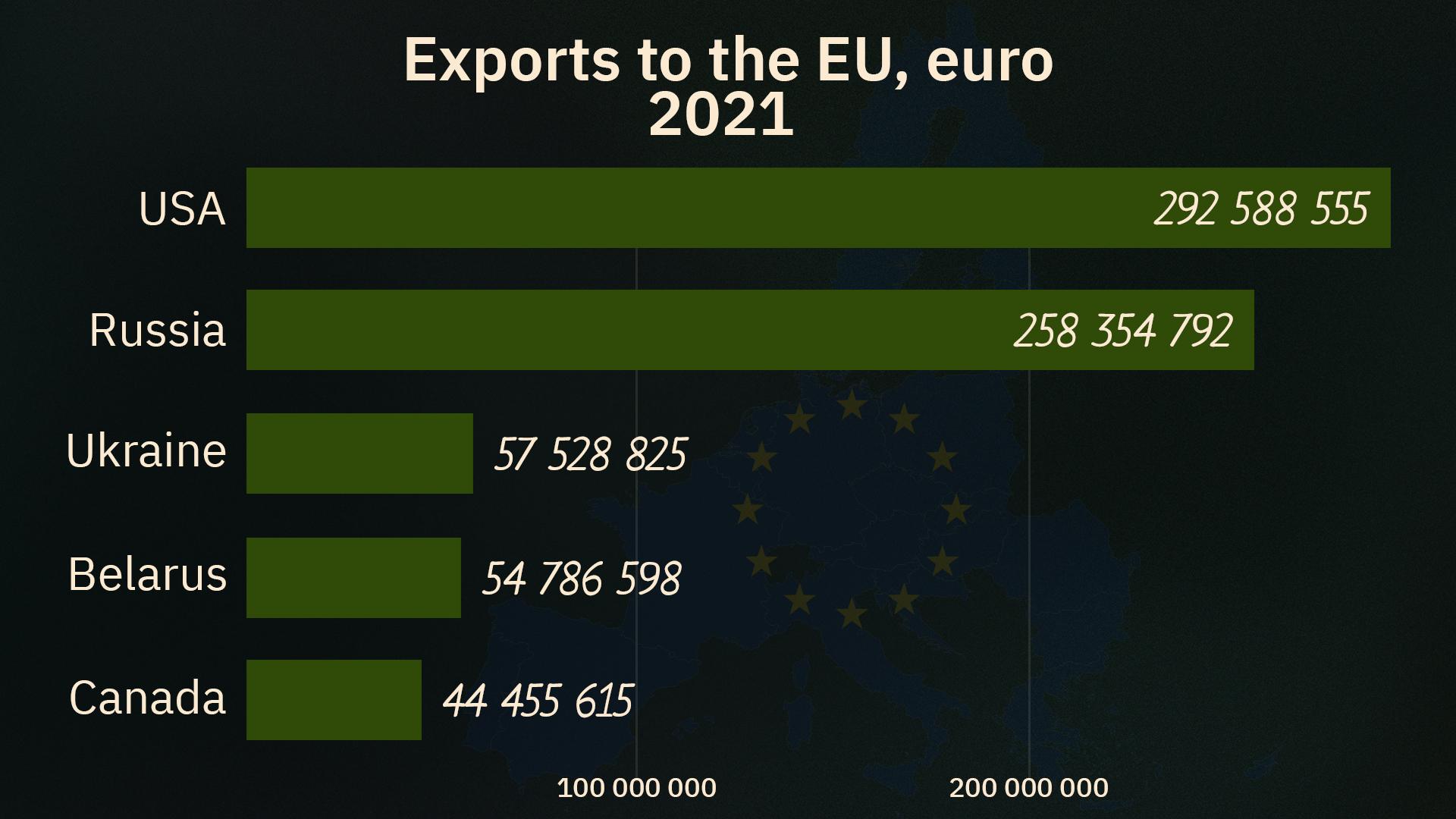
The following six countries have replaced Belarus and Russia in the European market: the United States, Canada, Brazil, Ukraine, Malaysia, Vietnam, and Türkiye. As of 2022, the first five were large pellet producers with annual capacities ranging from 0.5 million to several million tons. However, the last one appeared to be an outlier on this list. Before the embargo, Türkiye produced approximately 200,000 tons and exported 637 tons of pellets to the EU in 2015, increasing exports to 22,000 tons by 2021. Following the ban on pellet supplies from Russia and Belarus to the EU, shipments from Türkiye increased by a factor of 5.4. In a comment to the BIC, Ruslan Suleymanov, an Orientalist scholar from the New Eurasian Strategies Center, explained what could be the reason for this.
“In 2022, Türkiye became one of the key countries — if not the single most important one — for Russia to circumvent sanctions. ... Türkiye emerged as a hub for so-called shadow imports, and it was through Türkiye that shipments of sanctioned goods were delivered, at least throughout 2022, 2023, and partly in 2024. In addition, straw companies were established in Türkiye to facilitate interactions between Russian and Turkish firms and, among other things, to enable transactions in U.S. dollars. <...> Given the close cooperation between the Lukashenko and Putin regimes, large businesses — those linked to the state in one way or another — have used similar methods in both Belarus and Russia to evade sanctions, including through Turkish territory.”
The BIC investigators confirmed that attempts were indeed made to sell Belarusian pellets through Türkiye to circumvent sanctions.
Customs trace
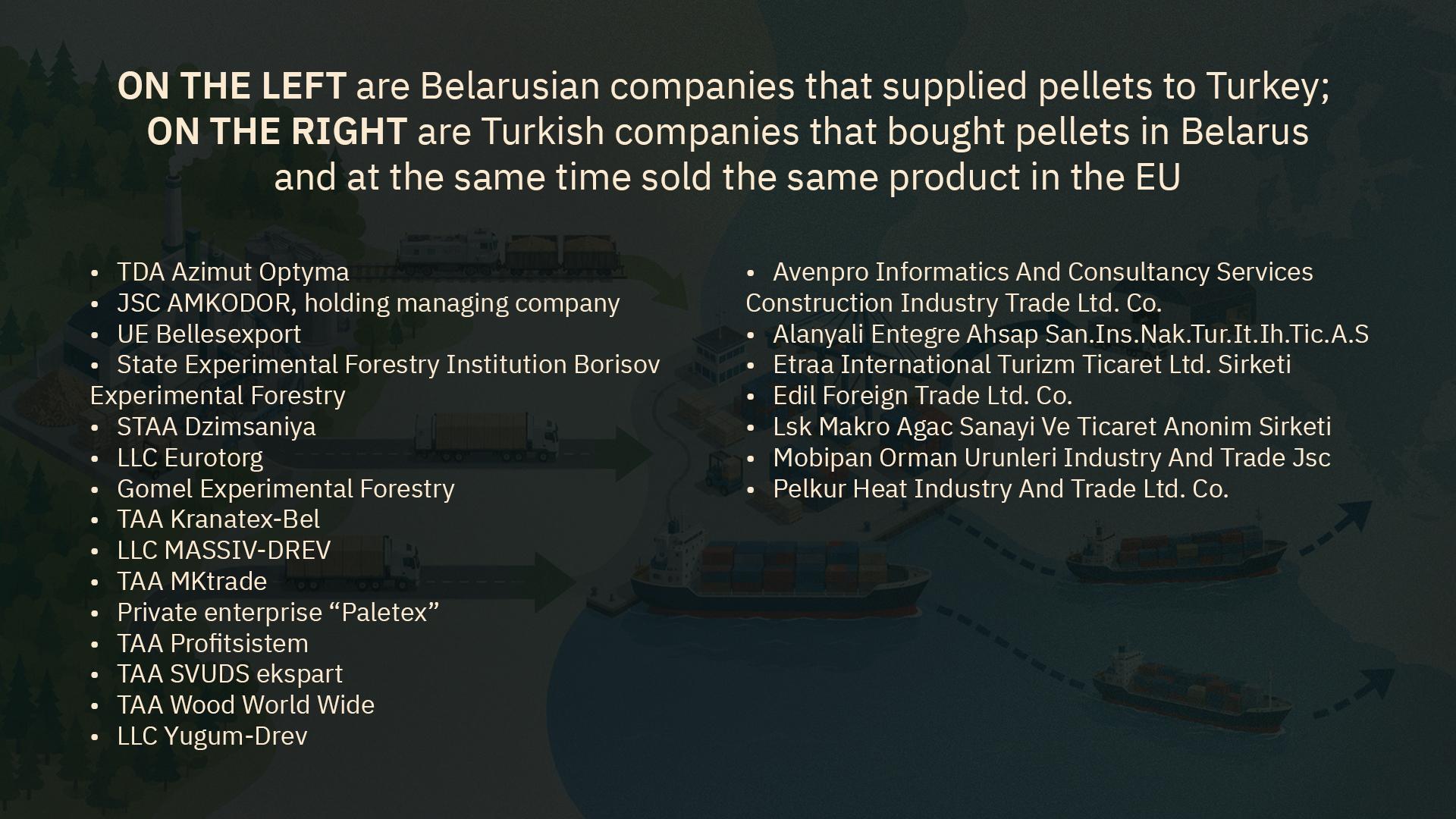
The BIC analyzed customs data from 2022 to 2025 and identified 81 shipments of Belarusian pellets to Türkiye, totaling $750,000. Fifteen companies from Belarus, eleven from Türkiye, and one from Poland took part in the transactions. Seven Turkish companies acted as importers and exporters: they purchased pellets from Belarus and then sold the same product in the EU, which could suggest re-exportation.
The example of the Belarusian TDA Azimut Optyma and TAA Kranatex-Bel illustrates how the scheme worked. From 2022 to 2024, they supplied approximately 150,000 kilograms of wood pellets to the Turkish company Lsk Makro Agac Sanayi Ve Ticaret Anonim Sirketi. During the same period, the company exported 900,000 kilograms of pellets to the European Union. According to international trade database records, part of these exports originated in Belarus and Russia. One European buyer of Belarusian products from Turkish LSK Makro Agac Sanayi ve Ticaret was the Polish company ANS Group Sp. z o.o. At the time of the shipment, ANS Group was managed by Belarusian national Andrei Kunts.He received a share of the company’s ownership in 2024, and his wife, Viktoryia, joined the management team. The family also owns Kunctrade Sp. z o.o., a Polish company that specializes in the wholesale timber trade.
“If a Polish company knowingly purchases Belarusian wood products, even via Turkey such an indirect purchase or imports are covered by the sanctions and rerouting through referred states is legally irrelevant” said Marcin Menkes, Professor at the SGH Warsaw School of Economics, assessing the legal implications of this cooperation.
In response to our request, the ANS Group emphasized that it could not verify the BIC’s findings regarding the supply of pellets and their source. The company noted that it operates in accordance with current legal norms, including those regarding EU sanctions. The company also verifies counterparties and trade documentation.
We found out how Belarusian timber floods EU markets via Kazakhstan and Kyrgyzstan.
Prominent and distinctive
Both private and state-owned Belarusian companies and forestry enterprises supplied locally-made pellets to Türkiye. The most famous among them are: JSC Amkodor, Holding Managing Company (AAT Amkador — Holding Managing Company); UP Bellesexport; and Eurotorg LLC (TAA Eurahandal), the owner of the Euroopt brand. Two lesser-known firms on our list have notable owners. One of the beneficiaries of TAA Profitsistem is Sergey Mezentsev, the full namesake of a former security officer of Aleksandr Lukashenko. The beneficiary of SWOODS Export FLLC (TAA SVUDS Ekspart) is Igor Rybakov, a Russian billionaire subject to sanctions by Poland and Ukraine.
Eurotorg Holding PLC, the owner of Eurotorg, described as inaccurate the information in our inquiry regarding shipments by its subsidiary to the Turkish company Pelkur Heat Industry And Trade Ltd. Co. The company stated that Eurotorg has never had commercial or other relations with the Turkish company Pelkur Heat Industry And Trade. Furthermore, commercial operations involving pellets do not align with Eurotorg’s business profile, as the company operates a retail chain specializing in food and consumer goods. The BIC’s request was ignored by the fourteen other Belarusian companies mentioned in the investigation.
Of the seven Turkish companies that imported pellets from Belarus and exported the same type of goods to the European Union, only one — Etraa International Turizm Ticaret Limited Sirketi — responded to our inquiry. The company confirmed that it purchased pellets from Belarus but sold the entire quantity domestically. The response specified that Türkiye had not imposed sanctions on Belarusian wood-processing products. Therefore, imports from Belarus were carried out in accordance with the legislation.
Polish intermediary
The only European company on our list that likely supplied Belarusian pellets to Türkiye is Poland’s Supinvest Sp. z o.o. It was established on May 9, 2022 — a month before the wood embargo took effect. The BIC checked two unrelated trade databases and found evidence that, six months after registration, the company began exporting Belarusian pellets. Supinvest made 10 shipments of wood pellets from Belarus to Türkiye in October and November of 2022. The total value of these shipments was $150,000. The product was acquired by Pelkur Heat Industry And Trade, a Turkish company that, according to database information, also received Belarusian pellets from Eurotorg.
“The fact that the wood [products] do not enter the EU in fact is irrelevant. Every time an EU operator, here, a Polish [company] — either transports or facilitates the transportation of Belarusian wood coming from Belarus to Turkey, it again most likely breaches EU sanctions,” said Marcin Menkes, professor at the SGH Warsaw School of Economics.
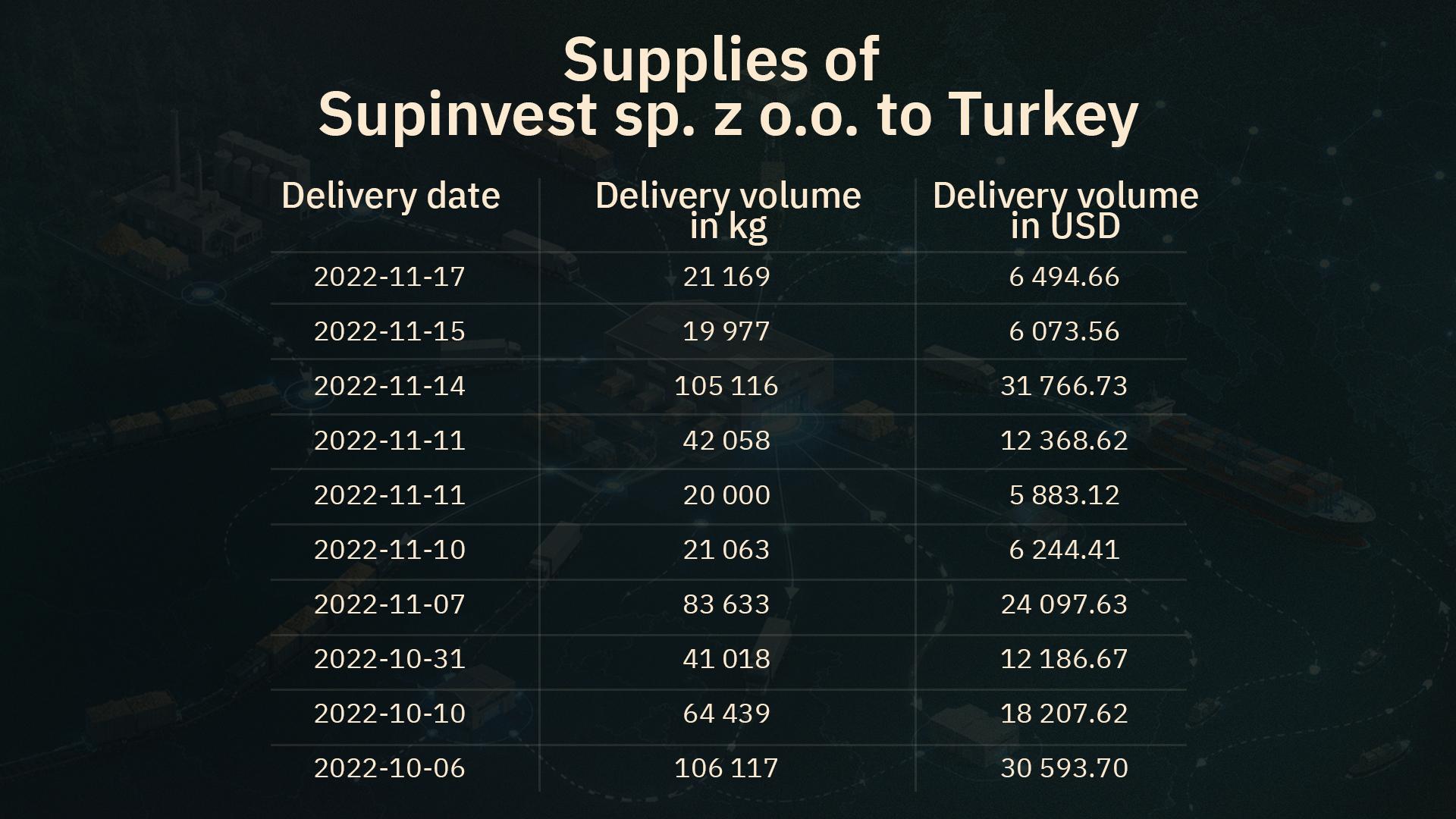
Anton Cwicinski and Natalia Cwicinskaja, citizens of Moldova and Poland, respectively, own Supinvest. Cwicinskaja is a Doctor of Law and an Assistant Professor at the Adam Mickiewicz University in Poznan, an expert in international law and human rights. She is a regular participant in prestigious international scientific forums, including events at the Universities of Oxford and Texas. Around a dozen of her publications in esteemed journals are available online, including ones on the legal consequences of the annexation of Crimea.
When asked to comment on the legality of the shipments, Natalia Cwicinskaja responded that, according to her information, they did not contain wood pellets. She also stated that, to the best of her knowledge, Supinvest complies with trade restriction regulations. She suggested that we contact the company directly for more precise information. The company responded, during the period in question, it did supply goods to Türkiye’s Pelkur Heat Industry And Trade.. However, the transactions did not concern wood pellets or other sanctioned goods. The company has the relevant documents, but did not attach them to the response, so we cannot verify their contents. The company added that its policy is based on compliance with sanctions regimes, trade bans, and other restrictions governing international commerce.
Sanctions as a wall
From 2022 to 2024, Türkiye exported nearly 250,000 tons of wood pellets worth €66 million to the EU. This is ten times the monetary value of exports in the previous three years. In 2025, the anomalous exports from Türkiye to the EU returned to pre-sanctions levels, with annual shipments worth around €3 million.
The documents the BIC received from Rabochy Rukh suggest that re-exporting Belarusian and Russian pellets through Türkiye proved economically infeasible. With the average price on the German market reaching €350 per ton in the autumn–winter period of 2023–2024, roughly half of that amount would have been consumed by the cost of transporting the product from Belarus to the EU via Türkiye. Consequently, the number of pellet shipments from Belarus to Türkiye has decreased year after year. Of the 81 pellet shipments to Türkiye identified by the BIC, 75 took place in 2022, when sanctions were introduced; 4 occurred in 2023; and only 2 in 2024.
According to the BIC’s estimates, the indirect re-export of Belarusian wood to the EU through Kyrgyzstan and Kazakhstan brought some 30 million euros to its organisers
The second problem for those wishing to sell Belarusian pellets in the EU was the specifics of the industry’s market. The draft letter from then-Prime Minister Raman Halouchanka to State Control Committee head Vasil Herasimau, which was provided to us by Rabochy Rukh, revealed exactly which one:
“An analysis of trade flows in the pellet industry shows that this market is transparent and traceable <...>, which does not allow the mechanics of the market to be changed quickly or fuel pellet supply flows to be redirected (for example, by using schemes involving changes in the declared country of origin of the goods).”
The officials’ correspondence details 17 attempts to circumvent sanctions. In nine of them, the companies lost money in nine of the transactions, and the European buyer was unable to pay the Belarusian state-owned enterprise in three of them. There was only one successful transaction. The buyer was the Estonian company MVG Trading OU, which is owned by Viachaslau Mihai, a Belarusian citizen. Attempts to deceive European customs officers by passing off Belarusian fuel pellets as goods from Kazakhstan, to ship pellets to Latvia through Russia’s northern ports, or to send them to Lithuania under the guise of Chinese goods ended in financial losses, account freezes, and, in one case, even a criminal case.
The Polish company Supinvest, mentioned above, may also have lost nearly €50,000.The correspondence between Halouchanka and Herasimau describes how the company purchased pellets from a state forestry farm but could not find a way to sell the products and did not export it from Belarus.. When Supinvest contacted the forestry farm to request a refund, the enterprise responded that the funds had been spent on the production and storage of cargo.
In another instance, a Turkish buyer failed to clear a large shipment of pellets transported by rail through customs in time.. The authorities seized the cargo for the benefit of the state. The total loss was about $300,000.
The attempt of the Kazakh company AV GROUP 2022 to deceive Polish customs officers was blocked by the customs authorities of Kazakhstan. They informed the Polish Prosecutor’s Office about the buyer’s violation of sanctions. As a result, the company’s accounts were frozen, and the owner went into hiding and stopped communicating. The buyer lost the €80,000 prepayment.
According to data from the Polish Prosecutor’s Office, which the BIC requested, 187 criminal cases were pending as of mid-2026 for circumvention of sanctions against Belarus and Russia. Since the restrictions began, nearly 2,500 cases have been registered. 85% of these cases concerned Belarus. At least 91 criminal proceedings were specifically related to wood-processing products. Some cases lead to arrests and trials. As of the time of publication, one of the latest examples is that, in December 2025, the Pomeranian Customs and Tax Administration detained three Poles and two Russians for forging dates on woodworking product contracts and falsely listing the goods’ country of origin as Kazakhstan or Türkiye. They now face 3 to 30 years in prison.
The burden of failure was shifted onto Belarusians
To save the industry after its export fiasco, the Belarusian authorities launched a program in May 2022 to increase fuel pellet consumption in the country. The program included experiments at CHP and cement plants to convert gas furnaces and boilers to pellet-fired units. As a result, enterprises agreed to purchase wood fuel at 37% below cost, making the deal unprofitable. At the same time, the authorities launched a program to increase the population’s consumption of pellets. The program provided compensation of up to 40% of the cost of pellet boilers from the state budget and the preferential sale of a fixed volume of wood pellets.
Siarhei Chaly, an economic observer and host of the Chaly: Economics show, described the program’s outcome:
“If you calculate the volume of pellet sales to households and divide it by the quota at which these pellets are purchased at a subsidized price, it turns out that the population has bought roughly 1,200–1,300 boilers. In other words, that is incredibly low, even compared with neighboring countries. Overall, this is a failure. <...> It is important to understand that even those 1,300 people who signed up for this program could end up in the worst possible situation if the [European Union] market for these pellets reopens. In that case, the price would be completely different — a European market price. The question then is whether the state would be willing to subsidize not only the boilers but also the cost of the pellets for households.”
By 2025, officials expected domestic pellet consumption in Belarus to reach 250,000 tons per year. However, the actual figure was only 52,000 tons, five times lower than expected. Despite the failure of the original plan, the Ministry of Forestry plans to build another pellet plant at the Uzda Forestry Farm. The project was frozen due to sanctions, but “there are plans to launch a new pellet-fueled boiler house in the district.” According to a journalist from a state-owned publication, “this opens up additional prospects.”