

Context: Vladimir Putin visited China less than a week after Donald Trump. They received an emphatically ceremonial welcome there, but neither visit resulted in the expected diplomatic breakthroughs. The U.S.-China talks ended with a trade deal, though not on the scale that the Americans had hoped for. Russia left without an agreement on the Power of Siberia 2 project. Against this backdrop, the Belarusian media began scrutinizing the details of the diplomatic protocol to show who Beijing considers a more significant partner.
On May 21, 2026, political scientist Vadzim Yalfimau appeared on Radio Minsk and shared his interpretation of Xi Jinping and Donald Trump’s walk through the Zhongnanhai residence. In his view, the Chinese leader used the occasion to signal to the American president whom he considers “friendlies.”
“And, by the way, Xi Jinping was very explicit about it… Remember when he hosted Trump at his residence? He said, ‘Before you, Putin and Lukashenko were here,’” he said.
However, the snippet of the conversation published by Reuters does not confirm this. In the recording, Xi Jinping can be heard mentioning Vladimir Putin by name, but Aleksandr Lukashenko is not mentioned. It is true, however, that during his 2025 visit to China, Lukashenko visited Zhongnanhai.
Another statement was made on Belarusian Radio’s First National Channel on May 15, 2026. According to blogger and political analyst Solomon Bernstein, Xi Jinping intentionally humiliated Donald Trump by failing to welcome him at the airport.
“And the symbolism, the subtext that Trump encountered there, showed that he was thoroughly mocked,” Bernstein said.
“And what exactly was that subtext and symbolism?” host Maksim Kharyn inquired.
“First of all, contrary to protocol, Xi Jinping did not personally greet Trump at the aircraft ramp. Instead, he sent 300 schoolchildren waving U.S. flags,” the analyst explained.
As head of state, however, Xi Jinping has never appeared at arrival ceremonies for foreign leaders. The Chinese leader was also absent from the airport on the day of Vladimir Putin’s arrival.
Xi Jinping’s absence from the tarmac greeting did not deviate from Chinese protocol. The difference was the level of officials who welcomed the delegations. Chinese Foreign Minister Wang Yi, a member of the Politburo and one of the most influential Chinese politicians, welcomed Vladimir Putin. Han Zheng, the vice chairman of the People’s Republic of China, greeted Donald Trump. Although his position is technically higher, observers consider him less influential because he is not a member of the CPC Central Committee’s Political Bureau.
During the same radio show, Iryna Novikava, a professor and a Doctor of Economics, said that Trump reevaluated economic indicators to ensure China did not surpass the United States in economic power.
“And in general, the era of U.S. dominance did not end now — it ended in 2016. For the first time — and I’m an economist — the curves crossed… GDP… Yes, I’m showing it with my hands. In 2016, China’s GDP surpassed that of the United States. That was when Trump came to power, during his first term. When he saw it, he said, ‘Recalculate it!’ And I personally saw it myself…”
“So they recalculated on Trump’s order,” commented host Maksim Kharyn.
“Yes, they recalculated it, and it turned out that China was now in second place,” Iryna Novikava claimed.
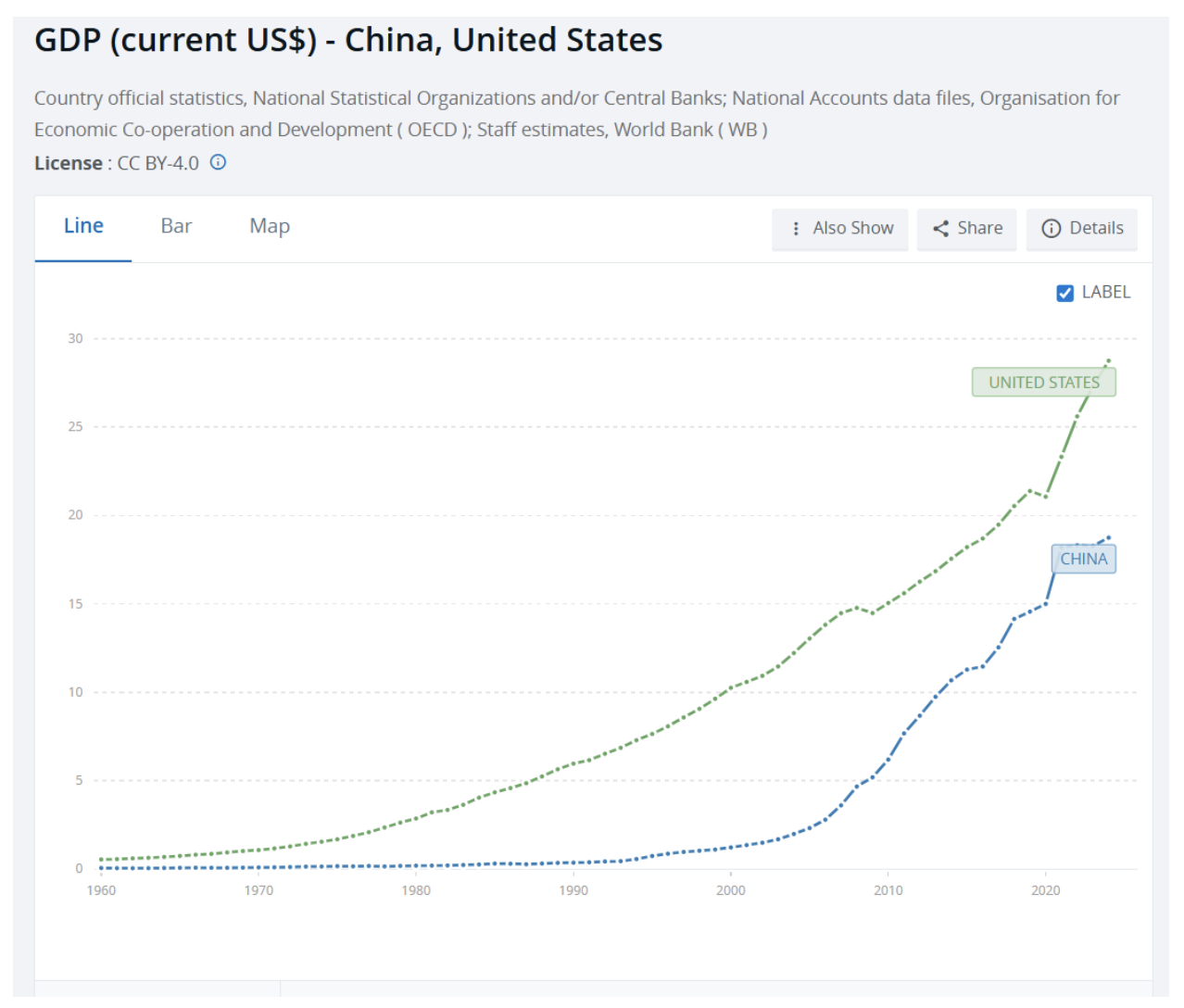
The professor did not specify in which exact GDP metric the curves of China and the United States supposedly crossed. After all, there are two different methods of calculating GDP. If you compare economies in nominal terms (then-current prices), the United States was the world’s largest economy in 2016 and remains so to this day. In 2016, the U.S. GDP was $18.7 trillion, while China’s amounted to $11.5 trillion. The difference is still too large for China to claim first place.
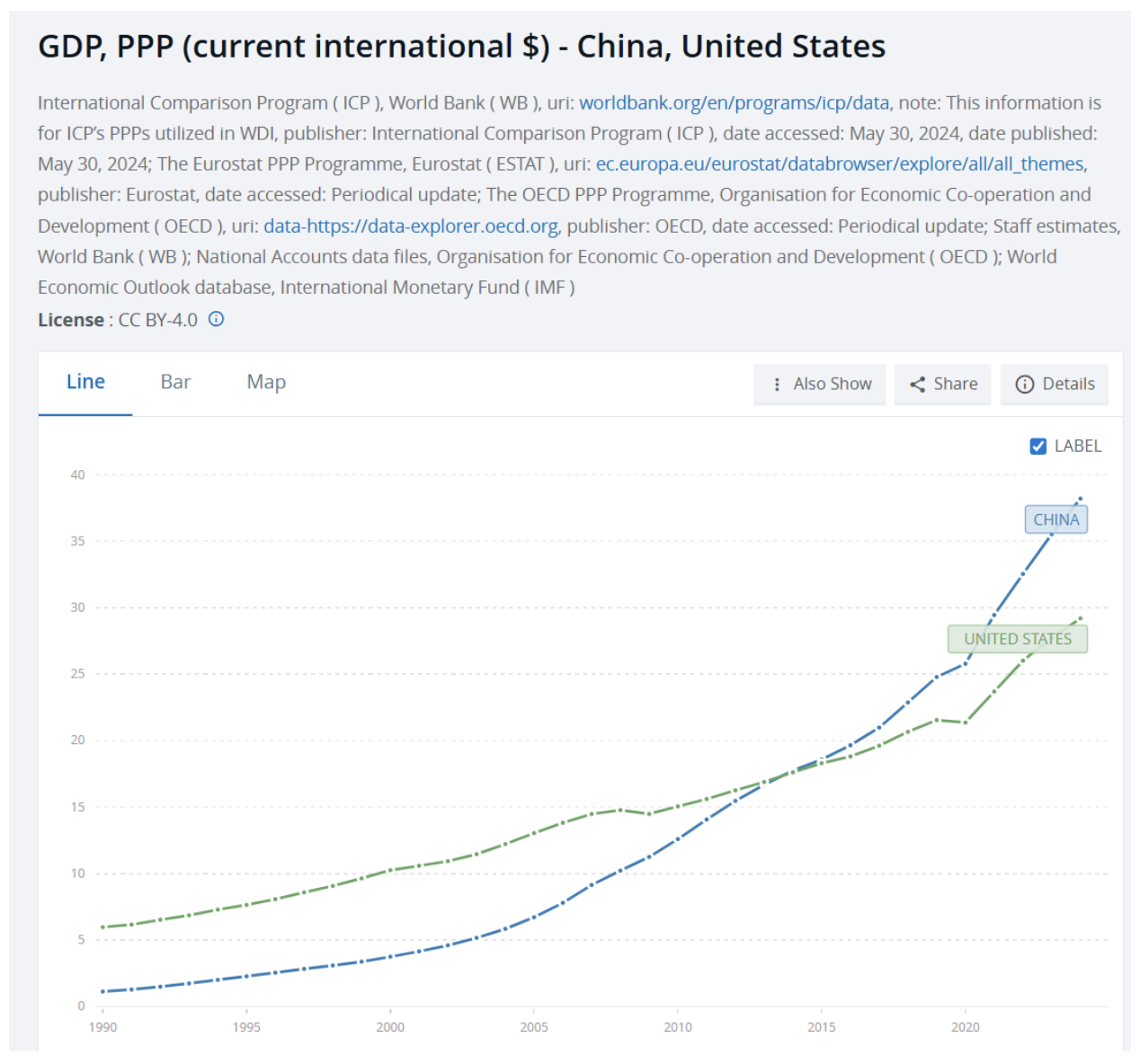
However, using a different methodology — GDP at purchasing power parity — the two countries’ curves did cross. China surpassed the U.S. on this metric in 2014, not 2016, before Donald Trump took office. China maintained its leadership after that.
Many countries, including the United States, regularly carry out the standard procedure of revising the methodology for calculating GDP. A major revision of U.S. statistics takes place every five years. Following the 2018 recalculation, the 2016 GDP figure rose by 0.1%. This change did not affect the positions of the U.S. and China in international rankings.